i've been spinning some samples of various fibers; seeing how they twist, if they're springy, shiny, fluffy, soft. it's been fun! in the photo below i've sampled (from left to right): bison, qiviut, peruvian color grown cotton, alpaca, cashmere/tussah/mink, red eri silk, paco-vicuna, bombyx silk. the softest to still-soft-but-not-as would go; paco-vicuna, bison, cashmere/tussah/mink, alpaca, cotton, bombyx silk, red eri silk, qiviut (it had a lot of guard hairs).
i would love to get my hand on more bison and paco-vicuna, that stuff is so very, very soft. i don't know what it is with the soft factor, because i love fabric with a bit of stiffness such as linen, and sericin silks, but when spinning i adore fiber which is like petting a baby animal. i turn into a drooling homer simpson gazing at donuts...
Showing posts with label alpaca. Show all posts
3.02.2012
11.29.2011
pj's are the ultimate comfort wear
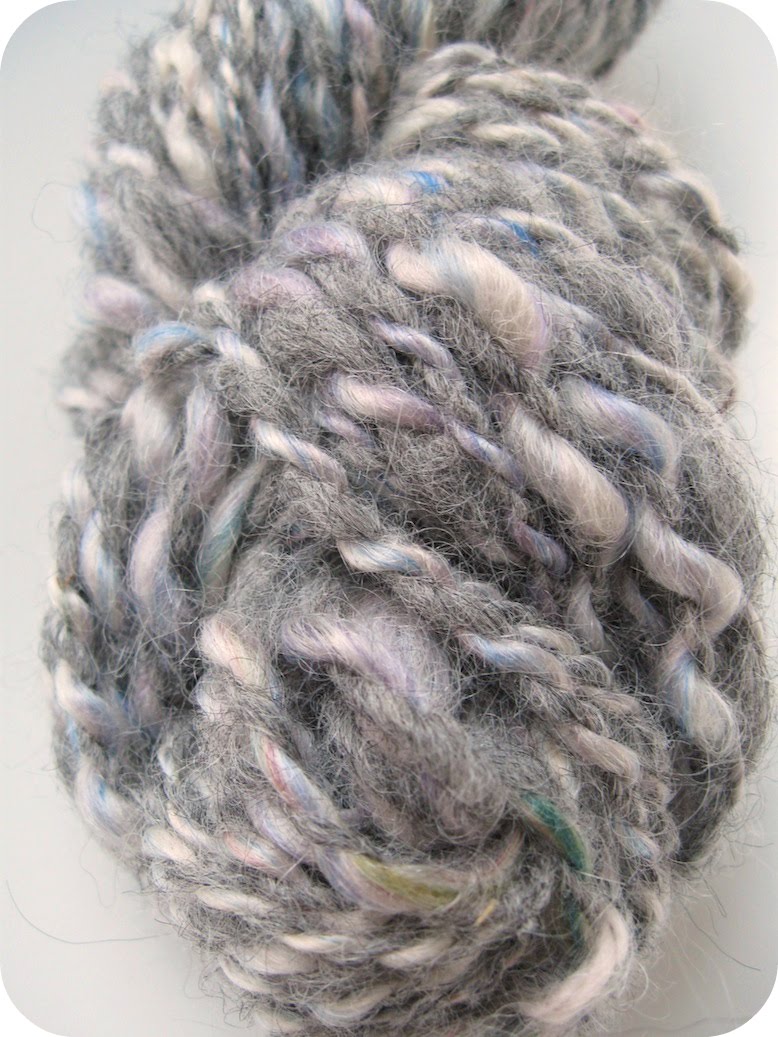
entire days off spent at home are seldom this month; i seem to always have somewhere to be, and things to do in town. today, i remained at home in my pajamas and it was wonderful! i spun up some chunky alpaca, finished my drop spun muga, finally skeined some handspun wool which i made a couple of years ago, and watched a movie on tv (the musical nine-really awesome). ah, there's never enough time anymore. like my friend bonnie says,"you either have the time or the money, but never both."
10.21.2011
feats of gene selection
the fiber compendium; for the pursuit of education and knowledge (f.c.p.e.k.) is coming along nicely. there are some gaps, but with more time and searching i can hopefully fill them. i'm really glad i decided to collect samples of so many fibers.
it's really remarkable how many types of silk there are, the different ways it's spun, and how all parts are used (waste, stem, pupae). there's definitely a "waste not, want not" mindset when it comes to this fiber. it reminds me of the way some of the native americans viewed animals; that by not throwing away any part of it, the death was not meaningless and the animals' sacrifice was respected. the life of the silkworm isn't wasted by it's death; oftentimes they are a food source, and the fact that the entire amount of silk it spun is used in some form or other is a great testament to how the people doing sericulture view and respect the silkmoth. peduncle thread, spun from the stems of the tropical tasar cocoon, along with ghicha, spun from the waste silk of muga and eri cocoons, were some of the more interesting spun silks i came across.
one of the things i had thought before starting this project was that there weren't too many cellulose fibers used for spinning and weaving cloth; only ramie, hemp, linen, cotton, and washi. but, i have more cellulose samples than animal fibers; baste fibers can be found in many plants, and the resourcefulness of humans is really inspiring! people have gone to great lengths to create cloth, from the attusi (elm tree inner bark) clothing of the ainu people of northern japan, to nettle fiber which has been used throughout europe for centuries.
with the animal fiber i've collected i found the different hair types within one animals' coat to be interesting; coarse to downy soft, strongly pigmented to lighter pigmentation, with a variety of uses for each type. browns, fawns, and creamy whites are the dominant colors in protein fibers. the brown hues lend the animal warmth from the sun in cold environs, and hiding ability amongst grasses and trees, whereas the white coloring, which is perfect for dyeing, seems to be a trait humans breed for (as albinism in the wild isn't really a common or safe trait).
the unique characteristics of the many natural fibers lend themselves to a myriad of uses, and i question why humans need to invent synthetics, when what is already there is so functional. with some better husbandry, more effective natural resource use, and respect for the organism which creates the fiber, many of these natural fibers can be just as viable as synthetics. some synthetic fiber inventions such as neoprene, are impressive, and needed, but to create a synthetic which does the same as a natural fiber just seems wasteful (and, like any copy, is never as good as the real thing, imho).
interesting reads:
an article about silk varieties, and degumming
the book, fibre facts, by bette hochberg
ebook, dictionary of textiles, by louis harmuth
"peace" silk, or the mythical perfection postulation
Labels:
alpaca,
baste fiber,
bison,
camel,
cellulose,
collection,
curricula silk,
fiber,
knowledge,
learning,
milkweed,
muga silk,
natural world,
organizing,
protein,
ramblings,
silk,
spinning,
vicuna
9.01.2011
submitting
here's the yarn stash i'm taking to the georgia national fair. it is a nice assortment of colors i think. there are definitely some which i will be keeping (they're so pretty, it would be hard to part from them), and some i will post to etsy when the fair is over. other entries you may have seen before if you read this blog; mini quilts, lap quilt, various cushions, weavings, smocked pin, beaded pin, etc.
8.19.2011
a snowball?
well, i managed to squeeze all of the alpaca on the drop spindle, and it doesn't look so much like a drop spindle as a softball with an antennae (or a jack in the box head). i wound it off, skeined it, and fulled it, and now have a lovely bundle of white alpaca laceweight.

i've been playing with the idea of dyeing it a soft aubergine with cochineal, but figured perhaps the white plainness may work in my favor. maybe. just guessing really. not going on any data to back this hypothesis up. we'll know in a month though, won't we?

the muslin sacks are all sewn up, corded, and tagged. it's a good thing i thought of labeling, as they're mostly indistinct from one another. i feel almost like a bank robber with sacks of money; hey, it's what they look like to me.

after picking up some color grown cotton roving yesterday, i'm down to two empty sacks. hmm. luckily i have enough cord and material for several more, and they're quick and easy to sew up.
Labels:
alpaca,
handspun,
organizing,
spinning,
storage,
turkish spindle,
white,
yarn
8.14.2011
mochi madness
getting ready for the fair, one of the categories which i am happy about is spindle spinning; which is a favorite pastime of mine. i have a mohair/silk and alpaca chunky yarn i've spun which i've entered; so for a little variety i decided to put my kuchulu to work and have been spinning a laceweight 2ply in white alpaca that i had helped shear.

one of the requirements is that the skein needs to be one to two ounces. which is fine, doesn't seem like a lot. but, when you're using a wee little drop spindle it sure seems like a ginormous amount to spin. each .20 ounce ball looks like little mochi, so cute!
i've borrowed my mothers delight spindle to ply, and i hope i can get it all on there. i have yet to master the joining of two separate 2ply strands (other than a knot). ah, well, something to aim for.
2.27.2011
an old one but a good one
my mentor and friend bonnie lent me one of her spinning wheels on friday. it's a lovely old wheel which has a lively history. while visiting england, she stayed with a friend who was in her eighties. this grand lady knew bonnie was a spinner, and decided to pass onto her this spinning wheel. she told her the story of it's provenance; when she was a girl of sixteen her scarborough beau crafted it as a gift of love. sadly though, he soon died, and they did not marry. bonnie brought it back on the plane, and her husband soon had it in tip-top shape. i'm very honored that my friend let me start my spinning on this wheel, and i was able to spin some soft grey alpaca on it today.
8.06.2010
i'm seeing plaid
one of the projects in weaving i completed, (if fulling is the last step in a woven piece, then i completed it yesterday) a german bird's eye twill. this was an interesting piece which i titledworldly camel, as it contains camel down yarn, handspun bamboo, cotton, and baby alpaca.
the warp was an experiment in using different colors and creating stripes. with the weft, i repeated the spacing of each warp color to create an asymmetrical plaid. i wanted to get as much out of the warp as possible, so the overall length of the piece is longer than planned; but that's okay as it makes a wonderfully soft wrap.

i like the strong blue lines, it makes the neutral cream and brown really pop. i had fun weaving this piece; even with the couple of weaving errors i can spot. herringbone, or as it is known in weaving lingo, twill, is one of my favorite patterns. overall, none too shabby for my first wool piece and my fifth weaving piece. i have three towels which were projects from an issue of handwoven still on a friends loom, and two beginner pieces finished, one a rag rug table runner, and the other a scarf, which i gifted to my mother.
Subscribe to:
Posts (Atom)