Showing posts with label fiber. Show all posts

3.09.2012

guanaco challenge

the other day i decided to give myself a handspun challenge; finely spin up guanaco, wild cousin of the llama. last year i got ahold of .5 oz of rich copper guanaco fiber. from my reading the deep color leads me to believe they came from an older animal; which you could never tell as the fibers are incredible soft and feel like the finest cashmere.


it wasn't necessary to card the fiber, just spin off of a fluffy handful. it was very easy to get a smooth and even strand. because of the inherent structure of the fiber it is very warm and i had to squash my desire to make a fluffy, slubby yarn, as it would have done a disservice to the fibers' nature. apparently, the warmer the fiber, the finer it needs to be spun; qiviut, bison, cashmere, vicuna, and guanaco falling into this category. as these fibers are also a bit pricey, you could spin a lot of yardage keeping this in mind. the half ounce spun up to about 172 yards which i then plied together, giving me 86 yds two-ply laceweight yarn. i haven't a clue as to what i'll make with it, so for now it stays in my spinning basket along with the bison and qiviut i'd already spun up.


10.21.2011

feats of gene selection

the fiber compendium; for the pursuit of education and knowledge (f.c.p.e.k.) is coming along nicely. there are some gaps, but with more time and searching i can hopefully fill them. i'm really glad i decided to collect samples of so many fibers.


it's really remarkable how many types of silk there are, the different ways it's spun, and how all parts are used (waste, stem, pupae). there's definitely a "waste not, want not" mindset when it comes to this fiber. it reminds me of the way some of the native americans viewed animals; that by not throwing away any part of it, the death was not meaningless and the animals' sacrifice was respected. the life of the silkworm isn't wasted by it's death; oftentimes they are a food source, and the fact that the entire amount of silk it spun is used in some form or other is a great testament to how the people doing sericulture view and respect the silkmoth. peduncle thread, spun from the stems of the tropical tasar cocoon, along with ghicha, spun from the waste silk of muga and eri cocoons, were some of the more interesting spun silks i came across.


one of the things i had thought before starting this project was that there weren't too many cellulose fibers used for spinning and weaving cloth; only ramie, hemp, linen, cotton, and washi. but, i have more cellulose samples than animal fibers; baste fibers can be found in many plants, and the resourcefulness of humans is really inspiring! people have gone to great lengths to create cloth, from the attusi (elm tree inner bark) clothing of the ainu people of northern japan, to nettle fiber which has been used throughout europe for centuries.

with the animal fiber i've collected i found the different hair types within one animals' coat to be interesting; coarse to downy soft, strongly pigmented to lighter pigmentation, with a variety of uses for each type. browns, fawns, and creamy whites are the dominant colors in protein fibers. the brown hues lend the animal warmth from the sun in cold environs, and hiding ability amongst grasses and trees, whereas the white coloring, which is perfect for dyeing, seems to be a trait humans breed for (as albinism in the wild isn't really a common or safe trait).


the unique characteristics of the many natural fibers lend themselves to a myriad of uses, and i question why humans need to invent synthetics, when what is already there is so functional. with some better husbandry, more effective natural resource use, and respect for the organism which creates the fiber, many of these natural fibers can be just as viable as synthetics. some synthetic fiber inventions such as neoprene, are impressive, and needed, but to create a synthetic which does the same as a natural fiber just seems wasteful (and, like any copy, is never as good as the real thing, imho).

interesting reads:
an article about silk varieties, and degumming
the book, fibre facts, by bette hochberg
ebook, dictionary of textiles, by louis harmuth
"peace" silk, or the mythical perfection postulation

10.20.2011

fall's sudden snow

fields of milk weed,
half open, puffy faced,
seeds floating in the wind
as if mimicking the coming snow. 

a fond memory from my childhood. in my search for fibers which are spinable, i remember the down-like fluff of the milkweed. sadly, they don't seem to grow as far south as me. though, happily, velma sent me a pod along with stem. both can be used, the pod fiber blended with other fibers for a spattering of shimmer, and the baste fiber of the stem can be spun similar to ramie, linen, and hemp. i am enjoying the search for fibers, and learning so much along the way. 

9.28.2011

squishy but not squid


alpaca is really an incredibly lovely fiber. i find it so soft and a joy to spin. of the 16 colors available i've sampled 6; white, light fawn, dark fawn, dark rose grey, light grey, and dark grey. thus far the browns feel softer and loftier than the white and greys (but not really by all that much, at that).

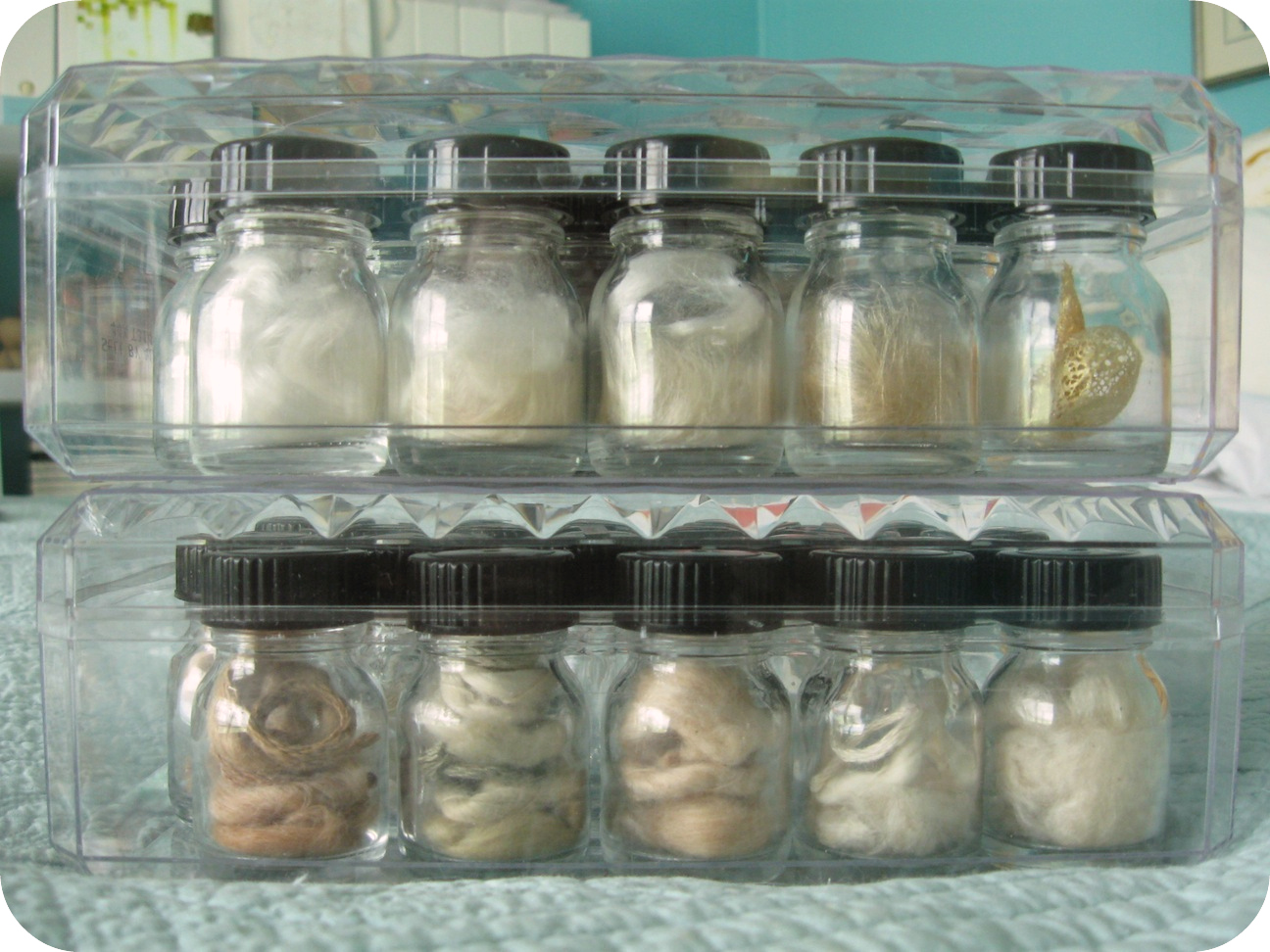
i've been collecting undyed unspun fiber specimens the last few months so that i have samples on hand to touch and examine when choosing fiber for spinning and weaving projects. i've also come to discover they're an important tool to educating myself on different fibers when you're shopping, or have an unidentified fiber in front of you. i've become very familiar with the samples i have and so it's gotten quite easy to identify fibers based on feel, smell (yes they have distinct smells), length, thickness, and color.


there are two boxes with 25ml jars: one cellulose fibers, and one protein fibers. the protein collection is nearing a somewhat complete state, with a few missing (anyone have any byssus they're willing to part from?). the cellulose fiber box is a little empty, but i'll remedy that when i order another habu sample book this coming december and place the older sample sheet offerings in their labeled jars.


what i've discovered is that vicuna, cashmere, bison down, are the softest, followed by guanaco, camel down, and alpaca. i found mohair and qiviut to be the springiest and least soft. i'm still on the shelf about the qiviut as i'm not 100% sure of the authenticity of the sample i have. i'm in need of new zealand possum (the ones not killed by poison), angora, pygora, and yak samples (the one yak i have is a blend of yak/tussah).

the silks are in a category all their own, they're just amazing; so soft and such sheen! i have cricula coccoons, muga silk, red eri silk, eri silk, tussah silk, bombyx silk, and both tussah and bombyx noils.

in the cellulose box there are 14 shades of color grown cotton from peru, pima cotton, organic cotton, and flax. i'll be adding nettle, ramie, hemp, pineapple, kenaf, kuzu, pine, zenmai (fern cotton), milkweed, and washi paper as i come across them. the milkweed fiber from the pod might be an issue as they don't grow in the south. any cellulose fiber i may have missed? i've left out soy silk, milk protein, corn, and seacell as they require too much processing to manufacture, so i'm a little leery about their environmental impact (actually come to think of it, i'm not really fond of bamboo for pretty much the same reason).


why no wool, you may ask? well...one, there are way too many breeds that collecting samples of them all would be quite a task, and two, i really don't like spinning wool. not at this point in my life. especially when you have soft alpaca to spin; no felting, degreasing, or lanolin to deal with!

p.s. if anyone reading this can help me out with small samples of the fibers i'm missing, i would be incredibly thankful! it's always nice to come across other fiber fanatics like me!

9.01.2011

mixing it up

i wrote this awhile ago, but hadn't posted it.

i started my trained art life in illustration, using paint and paper. since graduating, i've slowly leaned towards fibers, and have focused on them in the last few years. every now and then i would take out the paints and canvas, work on a piece, and once complete, put the paints away again.

 the other day i had an inclination to do some needle lace, so i grabbed a scrap of linen, and practiced some lace edging. it was a small piece, and i wasn't really sure what to do with it other than find some way of framing it. riffling around under my bed, i came across two canvases i've had forever. ah, inspiration! i took out the paints again, and have completed two canvas's incorporating my fiber work. i like the texture of fiber, the color of paint, the mixture of flat 2-dimensional and the slightly more dimensional fabric.

is this the beginning? who knows, but it is fun.

8.08.2011

mine, all mine! bwahaha!

one thing that happens when you go to a fiber event is that you come home with a lot more fiber than you had. i purchased some yak/tussah, muga silk, red eri silk, and cotswold locks. my teacher was more than generous with fiber, and i was more than greedy accepting it, so i also acquired silk noil, bombyx silk roving, wool, more wool locks, dyed tussah, a couple of silk hankies, and some wool "junk".


today i was thinking i needed some way to organize all this treasure, so i went about making muslin sacks out of some heavy duty muslin i had leftover from a patternmaking workshop. i was able to make nine of them before i ran out of cloth. i also need to get some cotton twine to use as drawstrings. labeled metal and paper tags will go on the cords so that i know what each is when they become a pile of similar muslin puffs. now i'll have no excuse for not spinning, as i am more than amply supplied with fiber. dyeing all this fiber should keep me occupied for some time as well.