Showing posts with label protein. Show all posts

10.21.2011

feats of gene selection

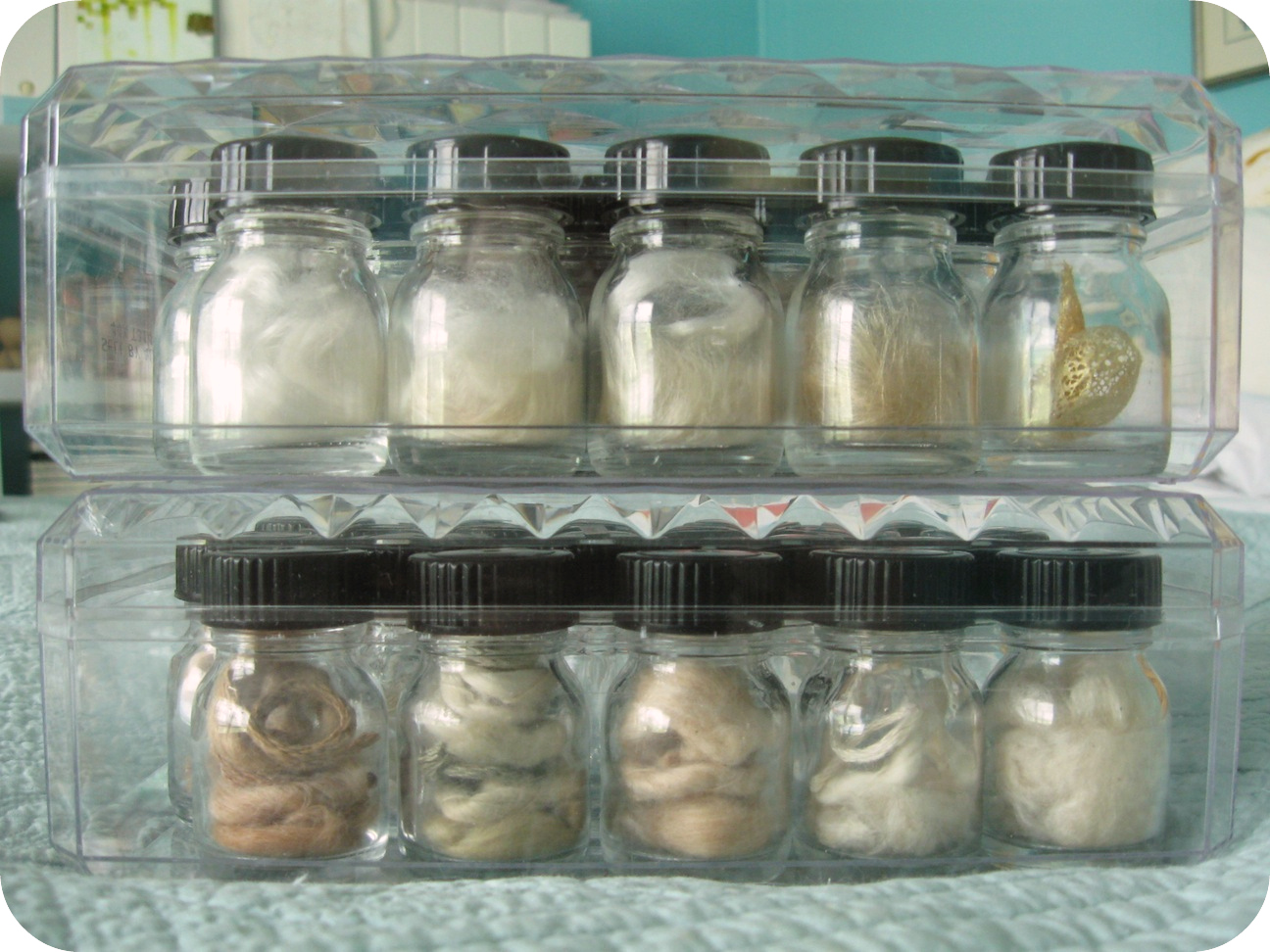
the fiber compendium; for the pursuit of education and knowledge (f.c.p.e.k.) is coming along nicely. there are some gaps, but with more time and searching i can hopefully fill them. i'm really glad i decided to collect samples of so many fibers.


it's really remarkable how many types of silk there are, the different ways it's spun, and how all parts are used (waste, stem, pupae). there's definitely a "waste not, want not" mindset when it comes to this fiber. it reminds me of the way some of the native americans viewed animals; that by not throwing away any part of it, the death was not meaningless and the animals' sacrifice was respected. the life of the silkworm isn't wasted by it's death; oftentimes they are a food source, and the fact that the entire amount of silk it spun is used in some form or other is a great testament to how the people doing sericulture view and respect the silkmoth. peduncle thread, spun from the stems of the tropical tasar cocoon, along with ghicha, spun from the waste silk of muga and eri cocoons, were some of the more interesting spun silks i came across.


one of the things i had thought before starting this project was that there weren't too many cellulose fibers used for spinning and weaving cloth; only ramie, hemp, linen, cotton, and washi. but, i have more cellulose samples than animal fibers; baste fibers can be found in many plants, and the resourcefulness of humans is really inspiring! people have gone to great lengths to create cloth, from the attusi (elm tree inner bark) clothing of the ainu people of northern japan, to nettle fiber which has been used throughout europe for centuries.

with the animal fiber i've collected i found the different hair types within one animals' coat to be interesting; coarse to downy soft, strongly pigmented to lighter pigmentation, with a variety of uses for each type. browns, fawns, and creamy whites are the dominant colors in protein fibers. the brown hues lend the animal warmth from the sun in cold environs, and hiding ability amongst grasses and trees, whereas the white coloring, which is perfect for dyeing, seems to be a trait humans breed for (as albinism in the wild isn't really a common or safe trait).


the unique characteristics of the many natural fibers lend themselves to a myriad of uses, and i question why humans need to invent synthetics, when what is already there is so functional. with some better husbandry, more effective natural resource use, and respect for the organism which creates the fiber, many of these natural fibers can be just as viable as synthetics. some synthetic fiber inventions such as neoprene, are impressive, and needed, but to create a synthetic which does the same as a natural fiber just seems wasteful (and, like any copy, is never as good as the real thing, imho).

interesting reads:
an article about silk varieties, and degumming
the book, fibre facts, by bette hochberg
ebook, dictionary of textiles, by louis harmuth
"peace" silk, or the mythical perfection postulation

9.28.2011

squishy but not squid


alpaca is really an incredibly lovely fiber. i find it so soft and a joy to spin. of the 16 colors available i've sampled 6; white, light fawn, dark fawn, dark rose grey, light grey, and dark grey. thus far the browns feel softer and loftier than the white and greys (but not really by all that much, at that).

i've been collecting undyed unspun fiber specimens the last few months so that i have samples on hand to touch and examine when choosing fiber for spinning and weaving projects. i've also come to discover they're an important tool to educating myself on different fibers when you're shopping, or have an unidentified fiber in front of you. i've become very familiar with the samples i have and so it's gotten quite easy to identify fibers based on feel, smell (yes they have distinct smells), length, thickness, and color.


there are two boxes with 25ml jars: one cellulose fibers, and one protein fibers. the protein collection is nearing a somewhat complete state, with a few missing (anyone have any byssus they're willing to part from?). the cellulose fiber box is a little empty, but i'll remedy that when i order another habu sample book this coming december and place the older sample sheet offerings in their labeled jars.


what i've discovered is that vicuna, cashmere, bison down, are the softest, followed by guanaco, camel down, and alpaca. i found mohair and qiviut to be the springiest and least soft. i'm still on the shelf about the qiviut as i'm not 100% sure of the authenticity of the sample i have. i'm in need of new zealand possum (the ones not killed by poison), angora, pygora, and yak samples (the one yak i have is a blend of yak/tussah).

the silks are in a category all their own, they're just amazing; so soft and such sheen! i have cricula coccoons, muga silk, red eri silk, eri silk, tussah silk, bombyx silk, and both tussah and bombyx noils.

in the cellulose box there are 14 shades of color grown cotton from peru, pima cotton, organic cotton, and flax. i'll be adding nettle, ramie, hemp, pineapple, kenaf, kuzu, pine, zenmai (fern cotton), milkweed, and washi paper as i come across them. the milkweed fiber from the pod might be an issue as they don't grow in the south. any cellulose fiber i may have missed? i've left out soy silk, milk protein, corn, and seacell as they require too much processing to manufacture, so i'm a little leery about their environmental impact (actually come to think of it, i'm not really fond of bamboo for pretty much the same reason).


why no wool, you may ask? well...one, there are way too many breeds that collecting samples of them all would be quite a task, and two, i really don't like spinning wool. not at this point in my life. especially when you have soft alpaca to spin; no felting, degreasing, or lanolin to deal with!

p.s. if anyone reading this can help me out with small samples of the fibers i'm missing, i would be incredibly thankful! it's always nice to come across other fiber fanatics like me!